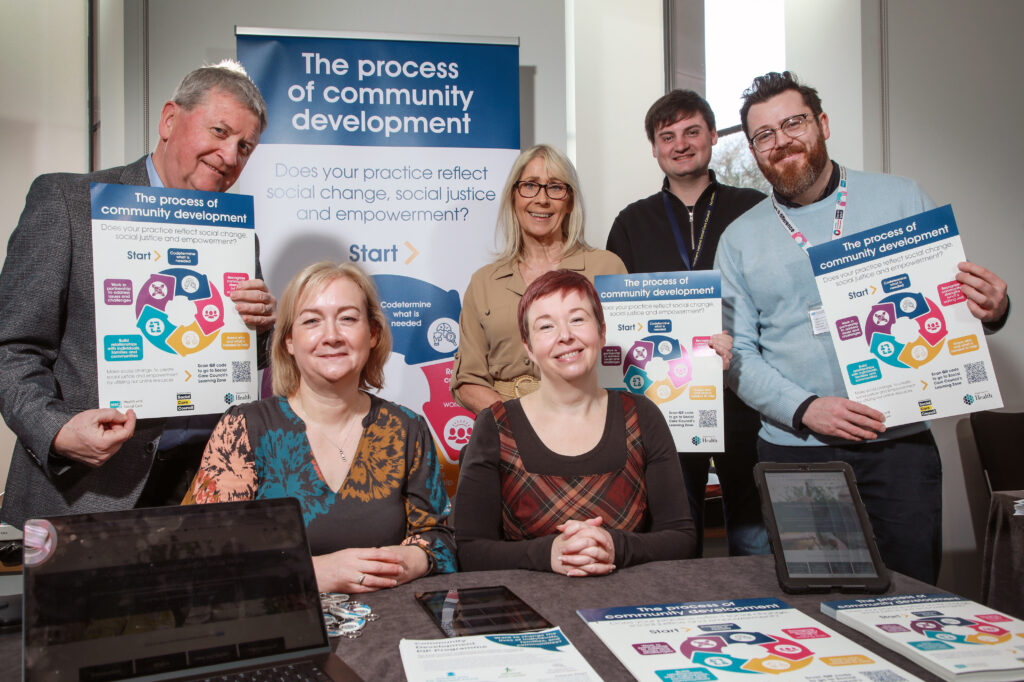
Community-based interventions are an important part of social work practice, leading to far more effective collective outcomes for people who need support in the community. This is the core of a new resource launched today by the Northern Ireland Social Care Council (the Social Care Council).
To strengthen the integration of community development values, skills and strategies into social work practice, a new resource launched this week – “Community Development in Social Work” – helps social workers understand what community-development–led practice can bring to their work.
The resource was developed for the Social Care Council’s Learning Zone, in partnership with Fergal O’Brien, Regional Programme Coordinator for the Social Work and Community Development Approaches (SWCDA) programme – a partnership Ulster University, Robbie McCague, Inequalities and Inclusion Coordinator, Southern Health and Social Care Trust and Eugene Kerlin, Regional Digitalisation and Promotions Lead for Social Work, Western Health and Social Care Trust.
During a special online launch event, over one hundred social workers and community development representatives from across Northern Ireland, heard contributions from social work leaders, experts and the Social Care Council, who talked about community development from their perspective, whilst explaining the new resources application in practice.
Social Care Council Chief Executive, Tracy Reid, spoke at the launch of the resource why community development is such a vital part of social work practice.
“Community development is about empowering communities to take action, build resilience, and lead positive change. So, it follows through that it should be part of everyday social work practice. For social workers it is about promoting collective action, for positive social change.
“We understand the very important contribution that social workers make to the lives of individuals, families and their communities. Working with a community development approach strengthens that contribution in a values-based and inclusive way. This new Learning Zone resource is a welcome tool to enable social workers to further develop their skills to work effectively and systemically within communities – with social work leadership at its core. I would encourage every social worker and social work student to make this resource key to their practice.”
Aine Morrison, Chief Social Work Officer, Department of Health added:
“Social workers provide support to those facing increasingly complex issues, including inequality, social exclusion, discrimination, marginalisation, and more. A community development approach brings power back to people and communities rather than focusing solely on individual problems. It can enable long-term, sustainable change rather than short-term fixes.
“I’m delighted to support the launch of this new resource, which I believe can make a real difference to communities in Northern Ireland.”
How to use the resource
Social workers can use the resource individually or as a small team to go through the resource and reflect, or as a springboard for team discussion or workshop — especially in settings where services support or work alongside communities, families, groups, networks. It can also be embedded into induction and ongoing training — as part of continuous professional development, especially relevant for practitioners, managers, and those developing strategy or pathways.
The resource offers a clear, practice-focused introduction to what community development means in the context of social work — and how a community development approach differs from traditional case-based social work. It also offers guidance on how social workers can embed values like social justice, empowerment, collective action, anti-discrimination, and equality in their everyday work.
There are also practical ideas and frameworks for working with communities: building trust, supporting collective learning, enabling communities to work together, to plan change, and influence policy or service delivery from the grassroots.
Social workers and community practitioners will share how these approaches have strengthened relationships, increased participation and created more sustainable, community-led solutions — all supporting better outcomes for individuals, families and communities.
The free, open access resource can be viewed on the Social Care Council’s Learning Zone at: www.learningzone.niscc.info/community-development-in-social-work. The resource will be subject to regular updates.
Ends.
Notes to editors:
1. What is the Learning Zone?
The Social Care Council’s Learning Zone is an online and interactive hub providing a free library of resources, along with dedicated sections for both social care practitioners and social workers – to support continuous professional learning and career pathways. It provides access to digital learning resources, including videos, interactive scenarios, relevant guidance and links to support the development of a safe, effective and competent workforce underpinned by regulatory standards and values.
2. For more information:
Rita McCullagh, Head of Strategic Communications and Engagement: Rita.mccullagh@niscc.hscni.net/07874682049