
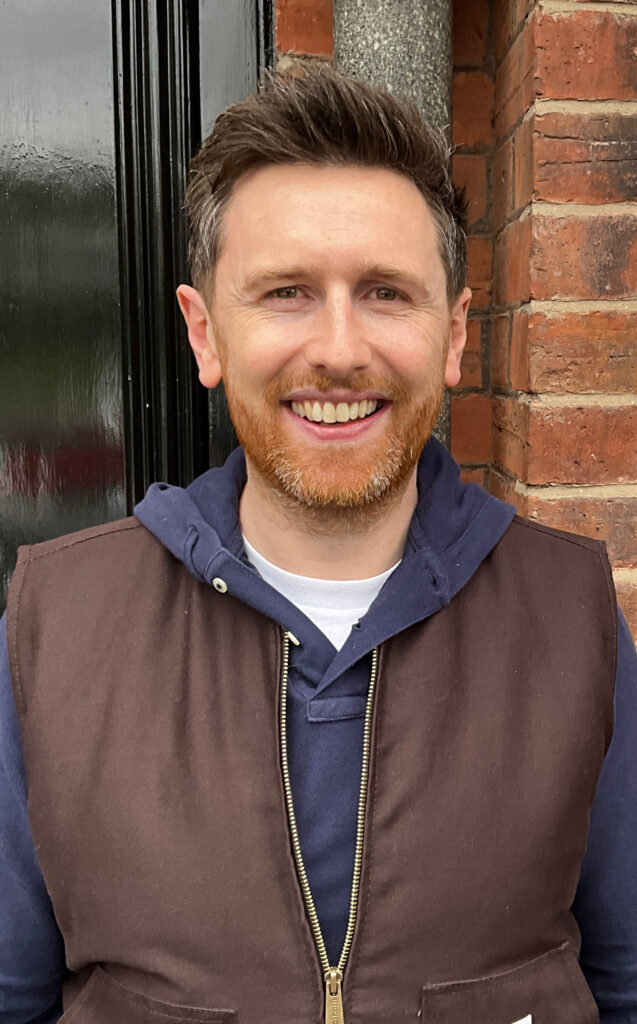
“I really like the idea that helping improve one area of someone’s life can be a positive.”
Social work and football on the surface could not seem more different; one thrives on physicality, competitive teamwork, and split-second decisions, the other demands emotional resilience, empathy, and deep human connections. However, Howard’s story shows these very different activities share more in common than you might think.
Howard Beverland enjoyed a semi-professional football career spanning 19 years, making over 200 appearances for Coleraine FC and more than 100 for Crusaders, alongside trials with West Bromwich Albion. Yet, for Howard, the lessons learned on the pitch have been instrumental in shaping his social work career, a career dedicated to supporting vulnerable young people and families. His journey is one defined by dedication, teamwork, and resilience, both in football and in social work.
Howard’s social work career began with a desire to make a tangible difference in people’s lives. “I’ve always enjoyed the idea of social work. I felt it opened up so many different roles because of its diversity and would provide me with opportunities for continued self-development as well.” Howard began studying for the Degree in Social Work in 2010 at Ulster University; his decision to pursue the Degree would also serve as a bridge between his love for sport, and his desire to make a difference.
The Degree was transformative. It offered more than theory, it provided a lens for understanding human behaviour, family dynamics and trauma. It gave him tools to navigate the complexities of real-life situations with empathy, structure and clarity. Versatility and agility sat at the forefront of his career pathway. Early in his career, he worked with older people and across Step 2 and Step 3 services in the Northern Health and Social Care Trust, gaining valuable experience with children and families.
Stay present, adjust quickly and support those around you
Developing his practice through education and hands-on experience prepared Howard to support young people in his current role with Child and Adolescent Mental Health Services (CAMHS) with the Belfast Health and Social Care Trust. Here, he has found an environment where professionals from different fields work together, allowing him to focus on direct, meaningful work with young people. Howard’s work journey, and sporting experiences, have shaped a perspective that considers the social, mental, physical, and environmental factors influencing human behaviour. Howard says, “I really like the idea that helping improve one area of someone’s life can have a positive, knock-on effect to another part of their development – that is true of social work, but also as part of a sporting team”
Naturally, social work isn’t without its challenges sometimes families may associate social workers with crises and removing children from their parents, when social work is about doing everything possible to keep families together where it is safe for the child. “It can generate a lot of fear or anxiety when the role of the social worker is not clear.” Howard’s Degree and experience prepared him not just for technical competence, but the human element of building trust, explaining roles clearly, and guiding families through often overwhelming and complex experiences.
Howard’s football career ran alongside his social work journey, creating a unique interplay between the two worlds. After a 19-year career, the discipline, teamwork and resilience he developed on the pitch profoundly shaped his approach to social work. Howard explains, “Football demands a lot of you, and you demand a lot yourself. Social work is also demanding because you’re working with people, high risk situations, and complexity. People can be unpredictable and not everything goes to plan.” Whether responding to a crisis or helping a young person navigate a familial situation, the lessons learnt from football were relevant to Howard’s day-to-day work – stay present, adjust quickly and support those around you.
Balancing both careers was no small feat for Howard. “I probably did put a lot of pressure on myself to do my best in football and social work, I was living life at a very fast rate, but, looking back, I can see that the discipline, routine and commitment required in sport were exactly what sustained me in social work.” The two paths reinforced each other with football teaching resilience and mental agility, and social work teaching empathy and reflection.
Bridging the gap between social work and sport
Since retiring from football, Howard has fused both passions into his work with the Players Football Association Northern Ireland (PFANI), which he co-founded and which includes sports chaplaincy. Recognising that there wasn’t a Players Football Association in Northern Ireland to support athletes, Howard helped create a platform focused on player welfare. “There is a lot more consideration of the players now, as high-level sport is a very highly pressurised environment with a relatively short career. The highs are very high, and the lows can be very low”, he explains. With his academic and practical expertise, Howard supports athletes through mental health struggles, stress, and career transitions, bridging the worlds of sport and social work. “Having those skills and my background within football can make other footballers feel a connection and probably adds another additional layer of trust and understanding between us.”
Ultimately, Howard’s journey from his decision to pursue the Degree in Social Work, to working in CAHMS, from football pitches to away-day matches, he built a career that leverages every opportunity he has had to support others. Reflecting this says, “Social work is a career where you must allow yourself time to develop within it. You’ve got to be prepared to grown a level of resilience, but also allow yourself to grow, too.”
For anyone considering social work, Howard encourages them to embrace the challenge, know their values and, if they align to social work values, be prepared to change and grow. As Howard demonstrates, the combination of education, experience, and empathy can turn diverse passions into a meaningful career. Football and social work are not worlds apart, they are complementary, each reinforcing the other.
Feeling inspired?
Find out more about the Degree in Social Work – both the undergraduate and relevant graduate routes – and how to apply here. You can also view our animation about the Relevant Graduate Route (RGR) degree route here.
If you would like to discover more about the different pathways people have taken into studying the Degree in Social Work, visit our YouTube page for our playlist here.