

Introduction

Welcome to the Summer edition of the Knowledge Exchange Newsletter. This newsletter provides an opportunity to report and reflect as well as feedback in addition to other recent updates, new initiatives and developments that have been happening locally, nationally and internationally.
This year has been a busy and exciting time for the social work and social care research and evidence world. We are delighted to have launched the consultation of the Social Work and Social Care Research and Evidence Innovation and Improvement Strategy which has been positively received. We are also planning to undertake a research priority setting exercise for social work and social care.
We have also started planning the 14th Annual Social Work and Social Care Research Conference in Riddel Hall, Stranmillis, Belfast. So please save the date and keep an eye on the website for further updates.

We hope that you find the range of information, news and updates in this newsletter interesting and feel free to share with others.
If you would like to sign up to receive this quarterly newsletter, just fill in the form here.
Thank you to everyone who has provided us with updates and information. It is important that you keep sending material so that the newsletter remains informative.
Yours sincerely,
Anne McGlade
Social Work and Social Care Research Lead
Social Care Council
“Research must continue to be the centrepiece of intellectual life, and our commitment to research must grow, because our problems are growing.“
– Ernest L. Boyer
Our news
Research, Evidence Innovation and Improvement Strategy

In April 2026 we opened a consultation of the Research, Evidence, Innovation and Improvement Strategy’s equality and diversity screening. The consultation closed on 22 July 2026.
We have been delighted to receive so many responses, as this supports the strategic direction for social work and social care in Northern Ireland for the next five years.
Excluding the equality and diversity screening questions, 24 questions were included, focusing on the strategy’s format, context and values and vision. All questions were answered by consultees.
From a few comments received some people found the ‘agree or disagree’ questions to be limited in their options for responses, we are satisfied that those who wished to, took the time to use the comment boxes which allowed to a more qualitative feedback.
On the ‘agree or disagree’ questions it has been reassuring that on a continuum, the majority of responders were at the highest level of agreement.
In devising the questions, we avoided ambiguity by not mixing positive and negative worded statements, as shown on the average counting.
See below for some very preliminary issues that we were able to identify from these additional comments;
- The majority agreed that the strategy was presented in a way that was clear and inclusive for the wider audience.
- The layout was easy to follow.
- The strategy offers an opportunity to promote engagement with research, internally within our organisation, and offers momentum for greater engagement of staff in research related activities.
- The infographics used in the strategy were helpful and clear, making the document easier to read.
- It clearly outlines what research is about and why it is important.
- It aligns well with the wider social, economic and workforce issues.
- A good overview was provided on what has been happening over the last decade but it was suggested that it should outline what has changed and why a new strategy is needed.
- The title could be made more accessible to people less experienced in research.
- In some places the language used was more academic and spoke better to professionals that it did to parents, carers, families and other people with lived experience.
- Whilst there was agreement that the explanations to make the word research “simpler” was helpful, further consideration is required to make it more accessible for a wider audience.
- The strategy would benefit from the inclusion of more real-life examples on how research and evidence can contribute to positive changes.
- For the majority, whilst the infographic and the design were helpful for some groups these were considered inaccessible.
- The questions that scored a lower rating were mostly in relation to impact, measuring outcomes, the strategy’s time line (whereby five years was considered too long by some), and the more challenging aspects of implementation. One response noted implementation was vague. In addition, there were issues raised on making co-production, equality, inclusion and diversity real, not just buzz words.
- There was an additional message offered on the need to give more attention to specific groups and individuals with specific needs and conditions.
Concluding comment
Now that the consultation has concluded, the working group will consider the breadth of the comments received, including the equality screening comments and how they can inform any revision of the final strategy. Responses where a request for the conduct of more research was noted and will be considered in the context of the forthcoming research priority setting exercise where we will endeavour to make it inclusive and related to the real world.
Regarding implementation, a wider debate is necessary on issues raised in relation to limited resources and the many other socio-economic and workforce constraints of doing research.
We appreciate the time given and effort made by people to respond to this consultation. A high number of responses received indicated that they had had no engagement with research. To those people a special thank you for taking the time to reply. We trust that there is something within the strategy that triggers an interest and engagement in future discussions.
“The best research you can do is to talk to people.“
– Sir Terry Pratchett
This highlights the value of qualitative research and direct engagement.
A full analysis of the feedback from the consultation exercise will be undertaken and an outcomes report will be produced.
“Creativity requires input, and that’s what research is. You’re gathering material with which to build.“
– Gene Luen Yang
Research and Evidence Partnership
We are delighted to welcome Colin Reid, Board Member of the Social Care Council, as the new chair of the Research and Evidence Partnership. Colin takes over the chairing of the group from Professor Davy Hayes, Queen’s University Belfast, a previous member of the Board who had supported the partnership since its establishment in 2023. At the partnership’s meeting in May 2026, members expressed their thanks and gratitude to Davy for his leadership and continuous support in the research agenda.
The partnership’s Terms of Reference outlined two key tasks; to oversee the development of a new research strategy and action plan and put in place a framework and implementation plan for a social work and social care priority setting exercise. Currently there are two working groups inclusive of members from both the partnership and our research community group who are working on these tasks. To read the Terms of Reference and find out more click here.
Research Community Group
The Research Community Group remains an important part of our research and evidence infrastructure. Membership now stands at 83, including social work and social care professionals, academics, frontline social work and social care staff, people with lived experience and carers.
The success of this network is the willingness of members to engage and share research and evidence material and initiatives.
Presentations are available here: Building our research community.
If you are interested in finding out more about the Research Community and become a member, email: swresearchsistrategy@hscni.net.
At the next meeting on 29 September 2026 we are delighted to welcome a colleague from New Zealand, Katheryn Margaret Pascoe who will be visiting Northern Ireland and accepted our invitation to present for this group.

A little bit of background about Katheryn
Dr Katheryn Margaret Pascoe is a Lecturer in the University of Otago’s Social and Community Work Programme. After qualifying and practicing as a social worker in Aotearoa, Katheryn Margaret later moved to the UK to complete her Master in International Development at the Institute of Development Studies, Sussex University. She also completed her PhD in social work and social policy at Ulster University in Northern Ireland.
Kathryn will showcase the method of a Delphi panel – as it is a much less known approach especially within the scope of qualitative research design. She will use an example of a recently completed study looking at the opportunities and limitations for developing a national training program for practice educators.
Whilst we in Northern Ireland are well ahead of New Zealand in terms of supporting social workers to develop in this role of practice teaching and area of knowledge and skill, it is always interesting to hear and learn what is happening in outside Northern Ireland.
PHD Network
If you are interested in finding out more about the Social Work PhD Student Network please email Dr Laura Doyle at: laura.doyle@qub.ac.uk or Liz Tanner at: Liz.tanner@southerntrust.hscni.net.
“Education must prepare students to be independent, self-reliant human beings. But education, at its best, also must help students go beyond their private interests, gain a more integrative view of knowledge, and relate their learning to the realities of life.“
– Ernest L. Boyer
PhD studies from members of the Research Community Group and Research and Evidence Partnership.
Spotlight – Bronagh Hamill

Bronagh is a Social Work Governance Manager in the Northern Health and Social Care Trust, as well as a part time PhD student at Ulster University. Bronagh is currently working on her PhD titled:
‘What are the implications of turnover and retention issues in children’s social work for organizations, social workers and service continuity?’
This mixed-methods, regional study seeks to explore the multi-faceted impact of social work turnover from a financial cost perspective, as well the potential manifold implications for social workers, managers, and service delivery.
Data collection is underway and involves participants across the five Health and Social Care Trusts. Bronagh had the opportunity to present the findings from her systematic narrative review to the Workforce Special Interest Group, at the European Social Work Research Conference 2026 in Aberdeen.
Bronagh’s academic supervisors are Professor Paula McFadden and Dr Rachel Naylor.
For more details email Bronagh at: Bronagh.Hamill@northerntrust.hscni.net.
Spotlight – Lisa Morrison
Lisa is a skilled trainer and consultant. She has been engaged for a number of years developing and delivering bespoke training to meet the needs of groups or organisations and is always keen to collaborate across disciplines to co-produce and co-deliver training. This training has application to various sectors including, but not limited to, Health Trusts, GP Practices, Police, Ambulance Services, Educational Settings and Community and Voluntary groups.
In 2022 Lisa was successfully funded by the Health and Social Care as a person with lived experience to undertake the Post Qualifying Research Methods Programme at Ulster University. Training alongside social work practitioners for three years, she gained skills in conducting a systematic narrative review followed by the conduct of an evaluation study and culminating in the acquisition of her Master’s Degree in Research and Production in 2025.
Referring to the post qualifying course Lisa commented:
“This course has been transformative, both personally and professionally. It has developed my critical thinking and equipped me with the knowledge of what quality research looks like.
As a person with lived experience, it has been so encouraging to learn alongside social workers and see and hear about their experiences and desire to improve the quality of their practice using research to advocate for better services. The course has equipped me with the confidence and knowledge which makes me far more effective at what I do”.
Since then, Lisa has presented her evaluation study on the well-being of approved social workers at local, national and international conferences and has successfully published in peer reviewed journals.
She also had the opportunity to present her study at DARE – Decisions, Assessment Risk and Evidence Conference in Zurich in June 2026. You can read the summary of her abstract below:
The well-being of Approved Social Workers: Emotional toil, ethical dilemmas and risk in context.

Background and purpose:
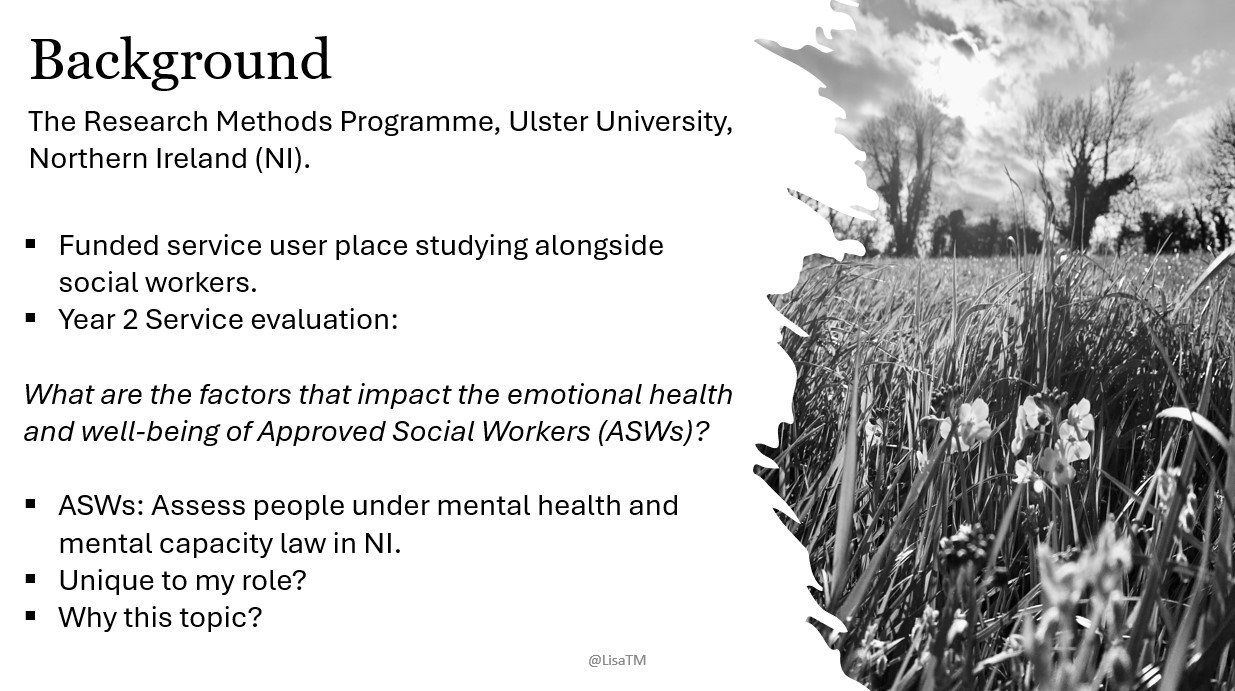
Approved Social Workers (ASWs) are specifically trained to conduct assessments under mental health and mental capacity law in Northern Ireland. The purpose of this service evaluation was to learn more about the impact of that role, and factors that challenge and support ASWs’ emotional health and well-being.
Methods:
The evaluation involved a qualitative interpretive approach using thematic analysis. Thirteen ASWs took part in semi-structured interviews. The researcher has previous experience of being assessed for detention, a unique aspect of the evaluation.
Findings:
There is a significant emotional impact to managing high-risk situations alone and co-ordinating multiple agencies with little control. Emotions ranged from, amongst others, fear, guilt and anger to pride and purpose advocating for others. All ASWs reported that their basic physical needs are often not met. Failures in service provision lead to ethical dilemmas causing moral injury. Some highlighted that current service pressures are causing harm to ASWs and service users, and a plan is needed to address this. ASWs fear being blamed if something goes wrong and described feeling abandoned, isolated and not valued. Lone working and not having a finish time were two key factors affecting well-being. Interprofessional tensions caused stress. Good family support is protective but extrinsic and intrinsic factors were variable depending on context. The Hub model, which involves a dedicated base and protected time, is seen as safer and more supportive than the old system. Support from ASW colleagues is central to nurturing well-being, and sharing emotions is welcomed and normalised. A learning culture with strong leadership and good supervision is highly valued.
Conclusions and implications:
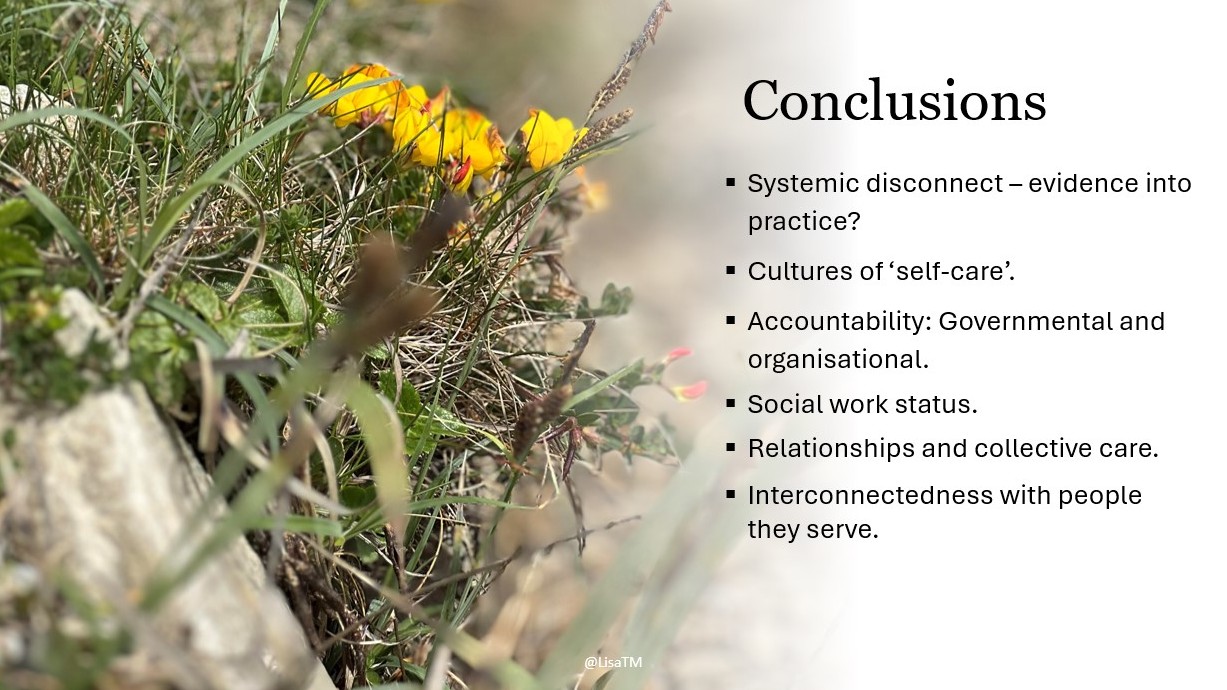
Research shows these same issues existed over twenty years ago but are now worse which raises questions about the gap between evidence and implementation. Given the small sample size, the findings should be interpreted with some caution, but they suggest major issues exist.
Sharing her reflections about the Dare Conference Lisa commented.
“It was such a privilege to be able to present my research at the DARE Conference. I never believed I would be well or capable enough to do something like this.
The research methods programme at Ulster University opened these doors and its vision for including service users and carers is leading the way internationally. Learning from others’ work across different contexts broadens one’s thinking and has practical application to my own work. It also encouraged us to consider how we ensure the evidence informs and improves practice.
A statement that stood out for me from Suzanne Ruig was: ‘Data is a moral compass’. And what we do with it is an ethical responsibility”.
Check out Lisa’s website here.
Spotlight – Lorna Montgomery

Professor Lorna Montgomery, Queen’s University Belfast also presented at the DARE conference.
The Impact of Area-Level Deprivation on Adult Safeguarding Interventions in Northern Ireland
Abstract:
While the “social gradient” of welfare inequalities is well-documented in child protection—where higher socio-economic deprivation correlates with increased intervention rates—there is a significant knowledge gap regarding its impact on adult safeguarding (AS). This study addresses this deficit by examining the relationship between area-level deprivation and AS intervention rates in Northern Ireland. The primary objectives were to investigate how deprivation influences different stages of the safeguarding process (screening, investigation, and planning) and to determine if these patterns vary by age or gender.
Methods:
This exploratory study utilized a quantitative secondary data analysis design. Researchers linked routinely gathered statistics from the Social Care Services Data (SOSCARE) system (2015–2017 and 2018-2021) to the Northern Ireland Multiple Deprivation Measure (NIMDM) using service users’ postcodes or postcode of a residential or nursing home.
Findings:
The analysis identified a distinct social gradient: for community referrals AS screening rates in the most deprived decile were 2.11 times higher than in the least deprived decile. In relation to links with deprivation in institutions, referral and outcome patterns were found to be influenced by area level deprivation. There was a clear pattern of decreasing screening rates as deprivation decreased. Screening rates per 100 places were 1.72 times higher in Quintile 1(area of high deprivation) compared to Quintile 5 (area of low deprivation). Social work responses differed according to location of the home, for example the percentage of investigations to screenings was 45% in Quintile 1 compared to 59% in Quintile 5.
Conclusions and Implications:
This study provides the first empirical evidence that macro-level structural factors, specifically socio-economic deprivation, significantly shape adult safeguarding trajectories. The findings suggest that AS interventions are influenced not only by individual risk but by environmental stressors and potential systemic rationing of resources. Thus, if you live in a community or within an institution in areas with higher levels of deprivation you are considerably more likely to be subject to an Adult Safeguarding referral, and the social work investigation and levels of support, may differ for those individuals living in areas of low deprivation.
Speaking after the event Lorna commented:
“It was a real privilege to attend the DARE conference in Zurich this year. There was a really excellent mix of presenters, many of whom are significantly advancing our understanding of the most effective ways that social work can work with and for the communities we engage”.
For more details, email Lorna at: l.montgomery@qub.ac.uk.
Other research agenda items
Proposed scoping exercise social work and social care research activity – 2026
The Social Care Council’s Strategic Research and Evidence Partnership leads on research and evidence in professional social work and social care services to support better outcomes for practitioners, service users and carers in Northern Ireland.
As part of this work, the partnership is leading on this scoping survey to establish the baseline of research and evidence related activities in social work and social care sectors across Northern Ireland. We are interested in any activity that is currently underway or undertaken within the last two years. This is important as research is regularly used to inform decisions in policy and practice.
We plan to launch this survey by August/September 2026
This scoping survey is for:
- Senior Managers and Team Leaders in Social Work (Across all services and organisations)
- Senior Managers and Team Leaders in Social Care (Across all services and organisations)
Why do your views matter?
This survey is important, as we go forward with the strategic research agenda, in providing a better view and understanding of the current landscape of research, evaluation and quality improvement activity across the social work and social care sectors in Northern Ireland. This will have a number of benefits including: helping identify strengths, gaps and duplication; improve coordination and collaboration; increase visibility and dissemination. Collectively this exercise will inform strategic planning as well as strengthening research and improvement culture across social work and social care in Northern Ireland.
More details to follow.
To read the Moral and Fiscal Impact of social worker turnover in children’s services report, click here. (Please note that this link will be available until October.)
Other news
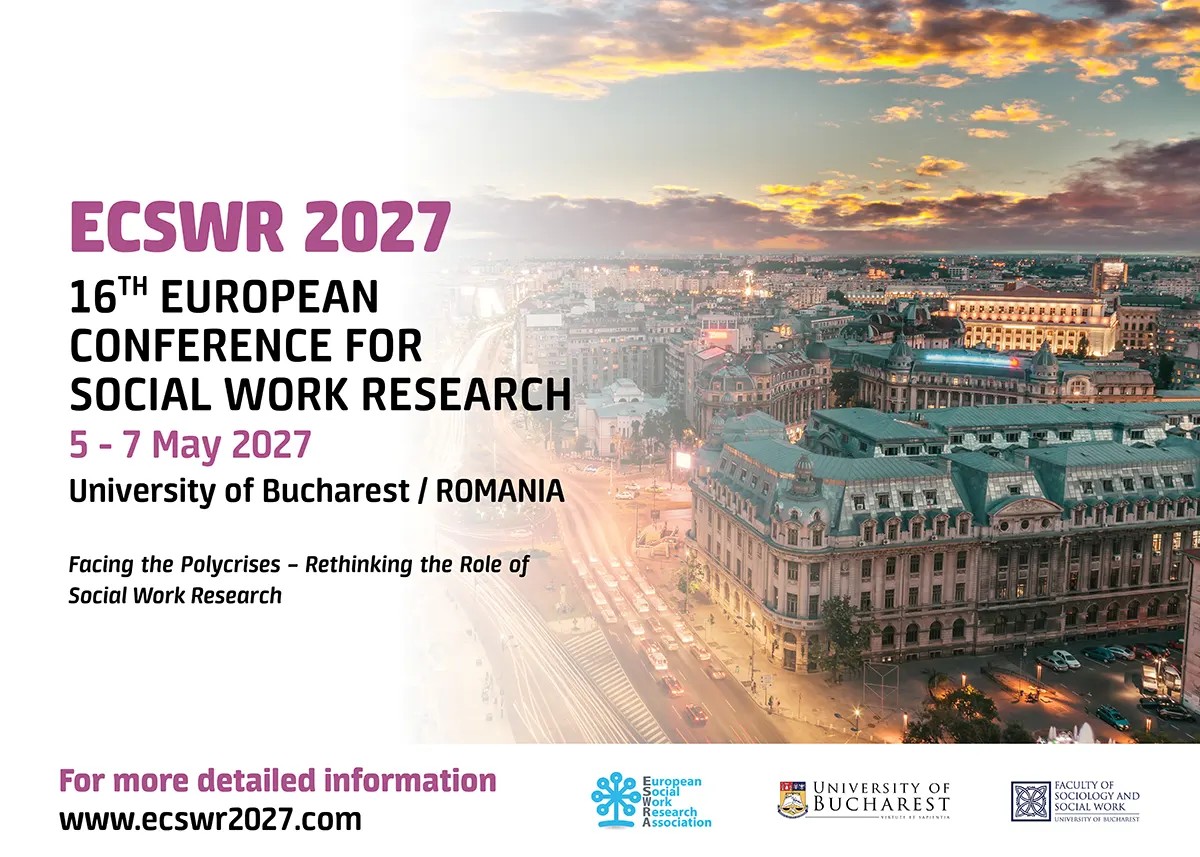
The European Social Work Research Association (ESWRA) was founded in 2014 to create a hub for social work research development, collaboration and exchange across Europe. Find information for next year’s conference in Bucharest here: ECSWR 2027 Bucharest here.
For an update from the 2026 ESWRA Conference in Aberdeen see link to Evidence into Practice Special Interest Group (EIPSIG) here.
You can read the most recent EiPSIG Newsletter here.
If you are interested in joining EIPSIG contact Anne McGlade at: EiPSIG@hscni.net.
Artificial intelligence and evidence for social work: will a robot steal your job? (Beth Coulthard, Brian Taylor and Anne McGlade). Read article here.
We are delighted that our recently published article ‘Artificial intelligence and evidence for social work: will a robot steal your job?’ in European Social Work Research has been selected by the editor of Bristol University Press and Policy Press for our Student Reading List collection.
This is a curated collection of social work scholarship to support course leaders when updating their reading lists. All articles in the collection will be free to access from July to September 2026 and will be promoted widely across our channels, including newsletters, Listservs and social media.
Read the full Student Reading List collection here. There are some very interesting pieces of research included.
Additional Special Interest Groups

Please find information about the British Society Gerontology here.
We have 12 Special Interest Groups for those interested in ageing.
Christine Wilson Brown is the lead for Care Homes Research interest group and she encouraging people to join as you don’t need to be a member of the BSG.
Christine is also happy to speak to anyone about the organisation and management of the SIGS as I represent all SIGs on the BSG National Executive Committee.
For more information contact Christine at: C.BrownWilson@qub.ac.uk.
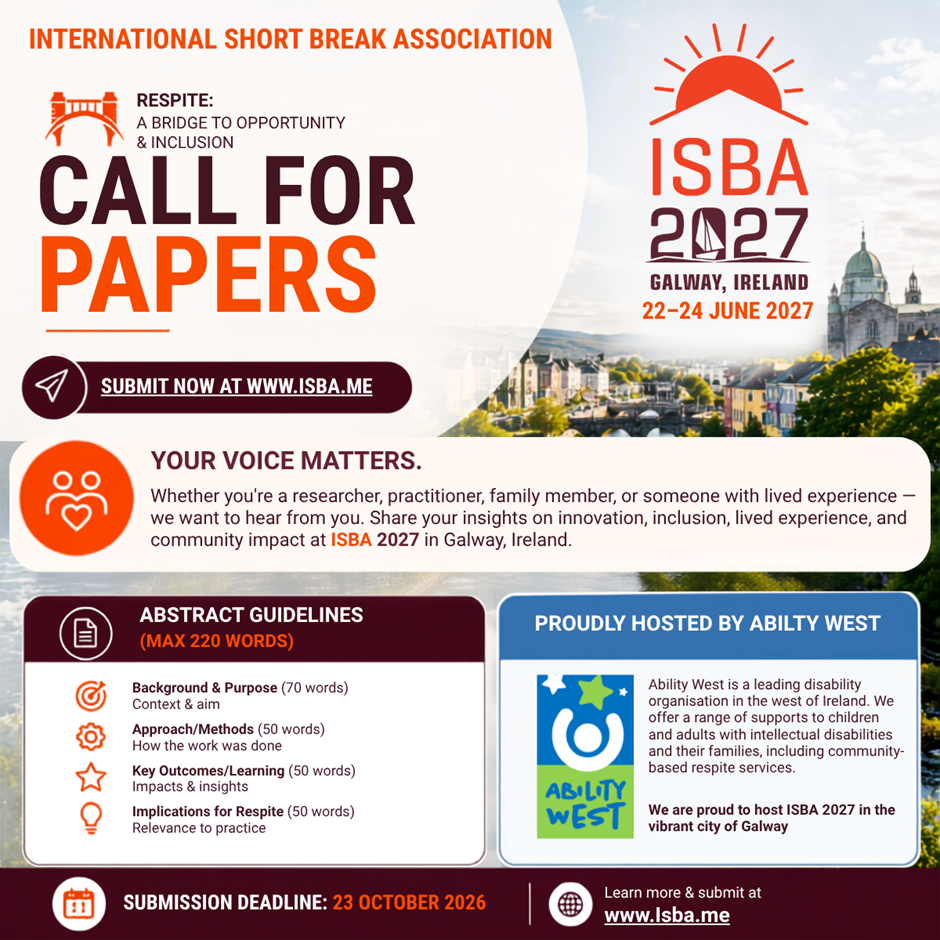
International Short Break Association
You can find out more information here.
Further reading
Have your say on Personal and Public Involvement in Research

Final ‘Involvement matters’ report is now available, click here to read full report.
For read more on research initiatives click here.
Keeping Up to Date – Social Work for Healthcare Library – Library Guides at Queen’s University Belfast

Some changes underway at Health Care Library
From early July, EBSCO databases, including CINAHL, SocINDEX and Health Business Elite, will have a fresh new look.
These databases are moving to a new interface designed to provide a more modern, accessible and streamlined experience, with improved navigation, searching and personalisation features. As a result, they will look and feel different after the upgrade.
While most saved articles and search histories will transfer automatically to the new interface, the following items will not migrate:
- Keeping Up To Date – Social Work for Healthcare Library – LibGuides at Queen’s University Belfast.
- New EBSCO User Interface – Healthcare Library – LibGuides at Queen’s University Belfast.
Do not hesitate to get in touch if you would like to invite Hazel Neale along to team meeting or an event you are hosting to introduce your colleagues to what is available within the Library service.
Please contact Hazel Neale at: Hazel.Neale@southerntrust.hscni.net.
“Research thrives on curiosity and scepticism. Every unanswered question opens the door to new experiments, new collaborations, and new ways of thinking.“
– Carl Sagan
Foundations

Reunification can be a pivotal transition for children, young people, and their families.
A return home is not a single event: it is a process that requires careful assessment, purposeful planning, shared decision-making, and sustained support before, during, and after a child returns home.
Check out the Re-unification Guide produced by What Works for Children and Families here.
IMPACT – Improving Adult Care Together

For the latest updates click here.
University College Cork – Practice Links

Practice Links is a free @UCCsocialwork publication for practitioners working in Irish social services, voluntary, community and non-governmental sectors. Practice Links supports practitioners to keep up-to-date with new publications, electronic publications, conferences, social media, apps, and continuing professional development opportunities. Practice Links is published every other month.
Click here to view the most recent issue.
If you have anything you would like to share with colleagues through Practice Links (events, publications, websites, reports, blogs, video links, new practice-focused apps, call for papers, useful social media accounts), please email: PL-L@listserv.heanet.ie.
On behalf of the Practice Links team Kenneth Burns, Kerry Cuskelly, Robert O’Driscoll, Louise McCormick, and Vivian Geiran.
““I would rather have questions that can’t be answered than answers that can’t be questioned.“
– Richard Feynman
Post Qualifying Research Methods Programme at Ulster University

A huge congratulations to our social work practitioners who successful gained their accreditation accredited PIP in Evidence into Practice for Social Work Practitioners (Systematic Narrative Review Module).
Leon Blue, Southern Health and Social Care Trust
Una Hume, Western Belfast Health and Social Care Trust
Patricia McGookin, Belfast Health and Social Care Trust
Rhonda Donaldson, Belfast Health and Social Care Trust
Danielle Boyd, Youth Justice Agency
Emma Clarke, South Eastern Health and Social Care Trust
Chloe Hughes, Southern Health and Social Care Trust
William Deery, Western Health and Social Care Trust
Maeve O’Connor, South Eastern Health and Social Care Trust
An Award Ceremony will be hosted on 10 March 2027 at the 14th Annual Social Work and Social Care Research Conference in Riddel Hall, Belfast.
If you are interest to find out more or apply for this course please contact:
- Module 1: Evidence Review Module – email Dr Campbell Killick at: c.killick@ulster.ac.uk.
- Module 2: Research and Evaluation Study – email Professor Paula McFadden at: p.mcfadden@ulster.ac.uk.
Horizons Research

To find out more about Horizons Research, click here.
Institute for Research and Innovation in Social Services (Iriss)

New project – ‘Social Care Changemakers’
IRISS are running a new fully funded project aimed at supporting leaders in social care to drive innovation and improve outcomes.
Three ‘Listening Sessions’ where we are asking care leaders to come and join us in conversation and influence this exciting new project.
Sign up for one of the following ‘Listening Sessions’:
Find out more details here.
Produced by the Social Care Council Research Team.

For any queries, questions or contributions please email: andriana.alkiviadou@niscc.hscni.net.