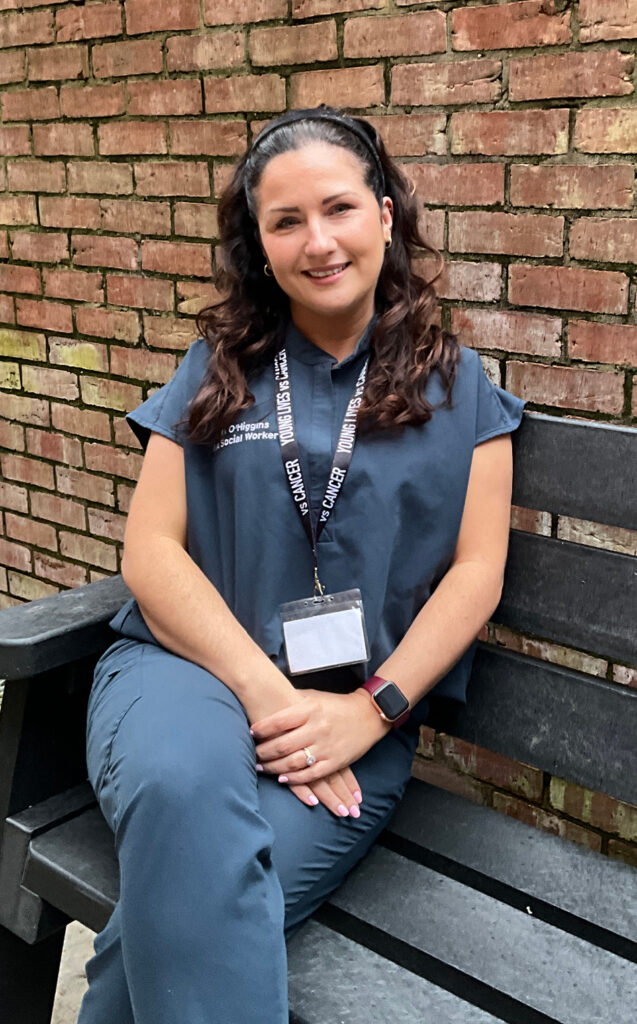
“Being invited into someone’s life at such a difficult moment is both challenging and deeply meaningful. It’s a privilege, and if you can take even a small amount of stress away from someone going through that, it’s worth it.”
Lori O’Higgins’ initial understanding of social work, like most people, was based on what she later discovered were inaccurate portrayals she saw on TV. Little did she realise then that even from an early age she showed instincts for what social work in the real-world entails.
As a child, Lori remembers feeling deeply connected to the experiences of others, with a natural curiosity which would lend itself to her future career. Passing someone on the street, she was naturally curious about their backgrounds and circumstances. “I’d see an elderly person and ask mum, ‘Are they going home to someone?’ If I saw someone homeless, I had endless questions,” she says. Looking back, Lori recognises that those moments reflected something deeper, an ability to place herself in someone else’s situation. That compassion was also nurtured at home; her mother studied counselling and volunteered with Samaritans, offering a first glimpse into what supporting others could look like in practice.
Finding the right path
Despite that early interest, Lori’s path into social work wasn’t completely straightforward. Originally from Killyleagh, she travelled to Dublin to complete Social Sciences Degree at University College Dublin, a course that included elements relating to social work alongside other disciplines. It offered her space to explore whether the social work was the right fit.
However, when she applied for the Degree in Social Work at Queen’s University after graduation, she wasn’t successful the first time. The rejection was difficult. “Not getting in on my first try was devastating, but rather than abandoning the idea, I took the time to gain experience working in social care. In hindsight, that extra experience was invaluable for my future practice and one of the most important steps in my journey,” Lori recalls.
Doubling-down on her career path with extra experience
Lori spent the next year working with young people in after-school clubs and summer schemes. This introduced her to children who were in foster care or facing difficult home circumstances. It was the first time she saw how wider systems of care supported vulnerable people.
She also spent time working with a charity, exposing her to services supporting adults with mental health challenges, while time working in a respite home for young people with learning difficulties highlighted the vital support families rely on. “I didn’t even know some of these services existed in my town, but they were making a huge difference to people’s lives in our community,” she says. Those experiences confirmed she had chosen the right path, “I knew I would be a social worker.”
What began as a setback allowed to Lori realise how committed she was to a career in social work and the next year she was accepted to Queen’s University Belfast’s Relevant Graduate Route (RGR) Degree in Social Work – an accelerated two-year programme designed for graduates with a relevant degree such as law, psychology, criminology or sociology.
A placement that changed everything
During her degree, Lori completed a practice learning placement working with young people affected by cancer. Admitting that whilst she was hesitant to take a role in hospital social work, her perception quickly changed. She discovered a role that combined emotional support, practical help and long-term relationships with families navigating life-changing diagnoses.
The experience shaped the direction of her career. “Being invited into someone’s life at such a difficult moment is both challenging and deeply meaningful. It’s a privilege, and if you can take even a small amount of stress away from someone going through that, it’s worth it. I remember thinking, ‘I’m going to work in this role one day,’” she says.
Supporting young people beyond hospital care
Today, Lori works with the charity Young Lives vs Cancer in Belfast, supporting young people aged 16 to 25 who have been diagnosed with cancer. Her role focuses on the non-medical impact of the illness. “I support families with the ripple effects. That can include practical support to help face extra costs during cancer treatment, emotional support during treatment, and advocacy with schools or employers. For many, a diagnosis comes at a time when life is just beginning to open up, and suddenly, those plans can be placed on hold,” she explains.
“We also provide bereavement support for up to two years. It can be hard but that’s why you have a team around you. We’re all there to help each other.”
Education is a particularly common concern. Exams, coursework, and school routines can all be disrupted by treatment. Lori often works with schools and exam boards to ensure young people receive the adjustments they need. She also helps to connect patients with peers going through similar experiences. In Northern Ireland, young adults with cancer are often treated with older patients, which can sometimes feel isolating. Bringing young people together can make a huge difference.
Changing perceptions of social work
Despite the vital role social workers play, Lori says sometimes people misunderstand the profession. TV dramas often portray social workers only in crises situations, mainly in child protection roles. While those roles are important, they represent only a small part of the profession. “Sometimes when I introduce myself as a social worker, people panic. Families can initially worry that something is wrong or that intervention means trouble, but those fears usually fade once they understand the supportive nature of my role. Over time, they realise I’m someone standing beside them,” Lori explains.
That simple idea of being present, supportive and reliable captures what social work means to her. Even in a job that can be emotionally demanding, it’s the resilience and courage of the young people that she works with that keeps her motivated.
For Lori, social work is about the quieter acts of support: advocating for a student, helping families navigate services, or simply being there when someone needs guidance. In other words, it’s about standing beside people when they need it most.
Ready to make a change in your career?
You can find out more about the Degree in Social Work – both the undergraduate and relevant graduate routes – and how to apply for it here. You can also view our animation about the RGR degree here.
If you would like to discover more about the different pathways people have taken into studying the Degree in Social Work, visit our YouTube page for our playlist here.